Identifying Warning Signs of Potential Violence
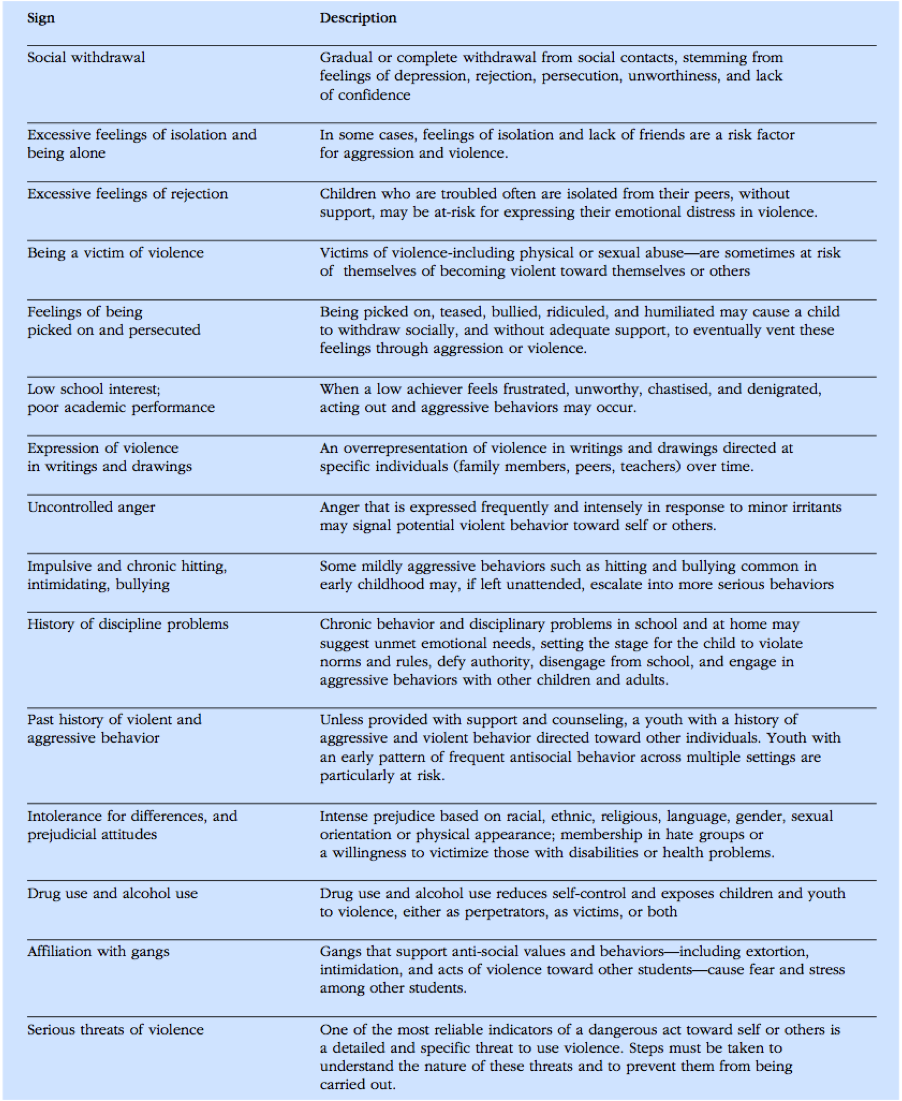
It is important to identify characteristics of persons who exhibit warning signs of potential violence. Those who display these signs should be referred to appropriate agencies or individuals such as counselors, parents, law enforcement, and social, medical, and mental health services. When deciding whether and where to make referrals, one should consider applicable regulations concerning parental consent, confidentiality, and mandatory reporting requirements.

These warning signs simply mean that a child appears to be troubled, and violence might be one of the possible outcomes of this distress. Neither stigmatize children nor assume that they will be violent just because they are at risk for such behavior. Other warning signs may also exist. Consequently, this list should not be considered all-inclusive, and certain items and combinations may be far more indicative of a potential problem than others. The signs include:
•Has engaged in violent behavior in the past.
•Has tantrums and uncontrollable angry outbursts abnormal for someone that age.
•Continues exhibiting antisocial behaviors that began at an early age.
•Forms and/or maintains friendships with others who have repeatedly engaged in problem behaviors.
•Often engages in name calling, cursing, or abusive language.
•Has brought a weapon or has threatened to bring a weapon to school.
•Consistently makes violent threats when angry.
•Has a substance abuse problem.
•Is frequently truant or has been suspended from school on multiple occasions.
•Seems preoccupied with weapons or violence, especially that associated more with killing humans than with target practice or hunting.
•Has few or no close friends despite having lived in the area for some time.
•Has a sudden decrease in academic performance and/or interest in school activities.
•Is abusive to animals.
•Has too little parental supervision given the student’s age and level of maturity.
•Has been a victim of abuse or been neglected by parents/guardians.
•Has repeatedly witnessed domestic abuse or other forms of violence.
•Has experienced trauma or loss in their home or community.
•Pays no attention to the feelings or rights of others.
•Intimidates others.
•Has been a victim of intimidation by others.
•Dwells on perceived slights, rejection, or mistreatment by others; blames others for his/her problems and appears vengeful.
•Reflects excessive anger in writing projects.
•Is involved in a gang or antisocial group.
•Seems depressed/withdrawn or has exhibited severe mood or behavioral swings, which appear greater in magnitude, duration, or frequency than those typically experienced by students that age.
•Expresses sadistic, violent, prejudicial, or intolerant attitudes.
•Has threatened or actually attempted suicide or acts of unfashionable self-mutilation.
Assessing Risk and Red Flags
While most threats that youths make are not acted upon, all threats whether written, verbal, or physical must be addressed and responded to.

What threats from youths should make you worry?
•Threats or warnings about killing or hurting themselves or others
•Threats to do something dangerous or potentially harmful
•Possession of or access to a weapon
Threat Assessment
When a youth makes a threat, you must assess:
- How serious is the threat that was made?
- What do you know about the youth who made the threat?
- Has the youth specified a plan to carry out the threat?
- Does the youth have the means to carry out the threat?
To help assess questions one and two, consider the “red flags” that research has found to be most associated with violence in youth.
• Past violent or aggressive behavior
• Bringing a weapon to school
• A pattern of violent threats when angry
• Alcohol or substance abuse
• Past destruction of property or criminal behavior
• Past cruelty to animals
• Past fire-setting
• History of family conflict or problems
• Gang involvement
Evaluation of any threat must be done in the context of the individual youth’s past behavior, personality, and current stressors. To help assess this, evaluate whether the threat or plan is realistic or could be accomplished; a 6-year-old threatening to blow up the school with an atomic bomb will probably present less risk than a 14-year-old threatening to kill a teacher with a gun. Access to guns or other weapons raises a threat to a potentially lethal level. Determining if there are guns present in a youth’s home or whether the youth is part of a gang that may have access to weapons will help to assess the risk of violence.
Risk Factors
There are known risk factors associated with potential violence toward self and others. It is important to keep in mind that none of these risk factors alone is sufficient for predicting violence, and it may be inappropriate or potentially harmful to use them simply as a checklist for an individual youth.
These lists should not be used to stereotype or stigmatize individual youths because they appear to fit a set of risk factors.
School Risk Factors
•Previously brought a weapon at school
•Aggressiveness in grades K-3, social isolation or hyperactivity
•Truancy, getting into fights or misbehaving in class
•Serious disciplinary problems
•Past suspension or expulsion for aggressive behavior
•Anger or frustration present in school essays or artwork
•Academic failure beginning in grade school (experience of failure escalates risk rather than ability)
Personal Risk Factors
•History of tantrums or uncontrollable angry outbursts
•Past violent behavior
•Characteristically resorts to name calling or cursing
•Bullying of peers or younger youths
•History of being bullied
•A pattern of violent threats when angry
•Cruelty to animals
•Fire-setting
•Use and abuse of alcohol or drugs
•Past suicide attempts
•Often depressed or has significant mood swings
•Tends to blame others for personal problems
•Recent experience of humiliation, loss, or rejection
•Preoccupation with weapons or explosives
•Poor peer relations, is on the fringe of peer group with few or no close friends
•Involvement with cults or gangs
•Unstructured time
Community and Environmental Risk Factors
•Extreme economic deprivation
•Low neighborhood attachment and community disorganization
•Access to guns or other weapons
•Past destruction of property or vandalism
•Few organized activities in community for youths
Family Risk Factors
•History of family violence
•History of weapon possession or use by family
•Abuse of alcohol or drugs by family members
•Family conflict
•Youth has history of being abused
•Severe or inconsistent punishment
•Absence of clear expectations or standards for behavior
•Lack of supervision or support from parents or caring adults