Chapter 7 – Action Steps for Crisis Management
Action Steps – Mitigation & Prevention
- Know the school building.
-
Assess potential hazards on campus. Conduct regular safety audits of the physical plant. Be sure to include driveways, parking lots, playgrounds, outside structures, and fencing. A safety audit should be part of normal operations. This information should feed into mitigation planning.
-
- Know the community.
- Mitigation requires assessment of local threats. Work with the local emergency management director to assess surrounding hazards. This includes the identification and assessment of the probability of natural disasters (tornadoes, hurricanes, earthquakes) and industrial and chemical accidents (water contamination or fuel spills). Locate major transportation routes and installations. For example, is the school on a flight path or near an airport? Is it near a railroad track that trains use to transport hazardous materials?
- Schools and districts should be active partners in community-wide risk assessment and mitigation planning. To help agencies work together, they may want to develop a memorandum of understanding (MOU), that outlines each agency’s responsibility.
- Bring together regional, local, and school leaders, among others.
- Given that mitigation/prevention are community activities, leadership and support of mitigation and prevention activities are necessary to ensure that the right people are at the planning table. Again, leadership begins at the top. Schools and districts will face an uphill battle if state and local governments are not supportive of their mitigation efforts.

Action Steps – Preparation
Start by identifying who should be involved in developing the crisis plan. Include training and drills. Delegating responsibilities and breaking the process down into manageable steps will help planners develop the plan. Follow these 10 steps:
- Identify and involve stakeholders.
- Identify the stakeholders to be involved in developing the crisis management plan (the people who are concerned about the safety of the school and the people who will assist when a crisis occurs). Ask stakeholders to provide feedback on sections of the plan that pertain to them. For instance, ask families to comment on procedures for communicating with them during a crisis.
- During this process, create working relationships with emergency responders. It is important to learn how these organizations function and how you will work with each other during a crisis. Take time to learn the vocabulary, command structure, and culture of these groups. Some districts have found it useful to sign MOUs with these agencies that specify expectations, including roles and responsibilities.
- It is essential to work with city and county emergency planners. You need to know the kinds of support municipalities can provide during a crisis, as well as any plans the city has for schools during a crisis. For example, city and county planners may plan to use schools as an emergency shelter, a supply depot, or even a morgue. Reviewing this information in advance will help you quickly integrate resources. Participating in local emergency planning gives school and district administrators insight into all the problems they might face in the event of a community-wide crisis and will help school efforts.
- Consider existing efforts
- Before jumping in to develop your crisis plan, investigate existing plans (such as those of the district and local government). How do other agencies’ plans integrate with the school’s? Are there conflicts? Does the comprehensive school safety plan include a crisis plan? What information from the district’s crisis plan can be used in the school’s crisis plan?
- If the school recently completed a crisis plan, efforts may be limited to revising the plan in response to environmental, staff, and student changes:
- Has the building been renovated or is it currently under renovation?
-
Is the list of staff current?
-
Have there been changes in the student population? Have other hazards revealed themselves?
- Determine what crises the plan will address.
- Before assigning roles and responsibilities or collecting the supplies that the school will need during a crisis, define what is a crisis for your school based on vulnerabilities, needs, and assets.
- Describe the types of crises the plan addresses, including local hazards and problems identified from safety audits, evaluations, and assessments conducted during the mitigation/prevention phase. Consider incidents that may occur during community use of the school facility and prepare for incidents that occur while students are off-site (e.g., during a field trip).
- Work with law enforcement officers and emergency responders to identify crises that require an outside agency to manage the scene (fire, bomb threat, hostage situations). Learn what roles these outsiders will play, what responsibilities they will take on, and how they will interact with school staff. Especially important is determining who will communicate with families and the community during an incident.
- Many schools and emergency responders use the Incident Command System, or ICS, to manage incidents. ICS provides a structured way for delegating responsibilities among school officials and all emergency responders during crisis response. An ICS and/or other management plan needs to be created with all emergency responders and school officials before a crisis occurs.
- Develop methods for communicating with the staff, students, families, and the media.
- Address how the school will communicate with all of the individuals who are directly or indirectly involved in the crisis. One of the first steps in planning for communication is to develop a mechanism to notify students and staff that an incident is occurring and to instruct them on what to do. It is critical that schools and emergency responders use the same definitions for the same terms. Don’t create more confusion because terms do not mean the same to everyone involved in responding to a crisis.
- It is important to determine how to convey information to staff and students by using codes for evacuation and lockdown, or simply by stating the facts. FEMA recommends simply using plain language rather than codes. If students are evacuated from the school building, will staff use cell phones, radios, intercoms, or runners to get information to the staff supervising them? Be sure to discuss the safest means of communication with law enforcement and emergency responders. For example, some electronic devices can trigger bombs.
- Plan how to communicate with families, community members, and the media. Consider writing template letters and press releases in advance so staff will not have to compose them during the confusion and chaos of the event. It’s easier to tweak smaller changes than to begin from scratch.
- Often the media can be very helpful in providing information to families and others in the community. Be sure to work with local media before a crisis occurs to help them understand school needs during an incident.
- Obtain necessary equipment and supplies.
- Provide staff with the necessary equipment to respond to a crisis. Consider whether there are enough master keys for emergency responders so that they have complete access to the school. Get the phones or radios necessary for communication. Ask for contact information for families. Maintain a cache of first aid supplies. What about food and water for students and staff during the incident?
- Prepare response kits for secretaries, nurses, and teachers so they have easy access to the supplies. For example, a nurse’s kit might include student and emergency medicines (“anaphylaxis kits,” which may require physician’s orders, for use in breathing emergencies such as severe, sudden allergic reactions), as well as first aid supplies. A teacher’s kit might include a crisis management reference guide, as well as an updated student roster.
- Prepare for immediate response.
- When a crisis occurs, quickly determine whether students and staff need to be evacuated from the building, returned to the building, or locked down in the building. Plan action steps for each of these scenarios:
- Evacuations require all students and staff to leave the building. While evacuating to the school’s field makes sense for a fire drill that only lasts a few minutes, it may not be an appropriate location for a longer period of time. The evacuation plan should include backup buildings to serve as emergency shelters, such as nearby community centers, religious institutions, businesses, or other schools. Agreements for using these spaces should be negotiated or reconfirmed prior to the beginning of each school year. Evacuation plans should include contingencies for weather conditions such as rain, snow, and extreme cold and heat. While most students will be able to walk to a nearby community center, students with disabilities may have more restricted mobility. Your plan should include transportation options for these students.
-
If an incident occurs while students are outside, you will need to return them to the building quickly. This is a reverse evacuation. Once staff and students are safely in the building, you may find the situation calls for a lockdown.
-
- Lockdowns are called for when a crisis occurs outside of the school and an evacuation would be dangerous. A lockdown may also be called for when there is a crisis inside and movement within the school will put students in jeopardy. All exterior doors are locked and students and staff stay in their classrooms. Windows may need to be covered.
- Shelter-in-Place is used when there is not time to evacuate or when it may be harmful to leave the building. Shelter-in-place is commonly used during hazardous material spills. Students and staff are held in the building and windows and doors are sealed. There can be limited movement within the building.
- Evacuations require all students and staff to leave the building. While evacuating to the school’s field makes sense for a fire drill that only lasts a few minutes, it may not be an appropriate location for a longer period of time. The evacuation plan should include backup buildings to serve as emergency shelters, such as nearby community centers, religious institutions, businesses, or other schools. Agreements for using these spaces should be negotiated or reconfirmed prior to the beginning of each school year. Evacuation plans should include contingencies for weather conditions such as rain, snow, and extreme cold and heat. While most students will be able to walk to a nearby community center, students with disabilities may have more restricted mobility. Your plan should include transportation options for these students.
- When a crisis occurs, quickly determine whether students and staff need to be evacuated from the building, returned to the building, or locked down in the building. Plan action steps for each of these scenarios:
- Create maps and facilities information.
-
In a crisis, emergency responders need to know the location of everything in a school. Create site maps that include information about classrooms, hallways, and stairwells, the location of utility shut-offs, and potential staging sites. Emergency responders need copies of this information in advance. During a crisis designate locations— staging sites—for emergency responders to organize, for medical personnel to treat the injured, for the public information officer to brief the media, and for families to be reunited with their children. Student reunification sites should be as far away from the media staging area as possible. Law enforcement will help determine the plans needed to facilitate access of emergency responders and to restrict access of well-wishers and the curious.
-
- Develop accountability and student release procedures.
- As soon as a crisis is recognized, account for all students, staff, and visitors. Emergency responders treat a situation very differently when people are missing. For example, when a bomb threat occurs, the stakes are substantially higher if firefighters do not know whether students are in the school when they are trying to locate and disarm a bomb.
- Be sure to inform families of release procedures before a crisis occurs. In many crises, families have flocked to schools wanting to collect their children immediately. A method should be in place for tracking student release and ensuring that students are only released to authorized individuals.
- Practice.
- Preparedness includes emergency drills and crisis exercises for staff, students, and emergency responders. Many schools have found tabletop exercises very useful in practicing and testing the procedures specified in their crisis plan. Tabletop exercises involve school staff and emergency responders sitting around a table discussing the steps they would take to respond to a crisis. Often, training and drills identify issues that need to be addressed in the crisis plan and problems with plans for communication and response. Teachers also need training in how to manage students during a crisis, especially those experiencing panic reactions. Careful consideration of these issues will improve your crisis plan and better prepare you to respond to an actual crisis.
- Address liability issues.
- Consideration of liability issues is necessary before crisis planning can be completed and may protect you and your staff from a lawsuit. Situations where there is a foreseeable danger can hold liability if the school does not make every reasonable effort to intervene or remediate the situation. A careful assessment of the hazards faced by the school is critical.

Action Steps – Response
- Expect to be surprised.
- Regardless of how much time and effort was spent on crisis planning, the members of the crisis team should know that there will always be an element of surprise and accompanying confusion when a school is confronted with a crisis.
- Assess the situation and choose the appropriate response.
- Following the plan requires a very quick but careful assessment of the situation. Determine whether a crisis exists and if so, the type of crisis, the location, and the magnitude. Because the team has practiced the plan, leaders are ready to make these decisions. After basic protective steps are in place, more information can be gathered to adjust later responses.
- Respond within seconds.
- When a crisis actually happens, make the basic decisions about what type of action is needed and respond within seconds. An immediate, appropriate response depends on a plan with clearly articulated roles and responsibilities, as well as training and practice. With proper training, district and school staff and students will respond appropriately within seconds.
-
Notify appropriate emergency responders and the school crisis response team.
- One common mistake is to delay calling emergency responders, such as the police or fire departments. In the midst of a crisis, people often believe that the situation can be handled in-house. It is better to have emergency responders on the scene as soon as possible, even if the incident has been resolved by the time they arrive, than to delay calling and risk further injury and damage. For instance, it is better to have emergency responders arrive at a school to find a fire put out than to arrive too late to prevent loss of life or serious property damage.
- Notifying a district’s or school’s crisis team allows them to begin the necessary measures to protect the safety of all persons involved. Unless informed otherwise by the incident commander, school crisis team members should proceed with their responsibilities.
-
Evacuate or lock down the school as appropriate.
- This step is crucial and should be one of the first decisions made, regardless of the order in which initial decisions are implemented.
-
Triage injuries and provide emergency first aid to those who need it.
- The plan should assign emergency medical services personnel and school staff with relevant qualifications to determine who needs emergency first aid. Designate a location for EMS to treat the seriously injured on the scene.
-
Keep supplies nearby and organized at all times.
- If you move to another location, remember to take your supplies with you. Monitor the amount of supplies and replace them as needed.
- Trust leadership.
- Trust the internal crisis team members and external emergency responders who have been trained to deal with crises. Trust will help calm the situation and minimize the chaos that may occur during a crisis.
- During a crisis, leaders need to project a calm, confident, and serious attitude to assure people of the seriousness of the situation and the wisdom of the directions being given. This leadership style will help all involved to respond in a similarly calm and confident manner, as well as helping to mitigate the reactions of anyone who might deny that a crisis has occurred.
- In certain situations it may be necessary to yield leadership to others in the plan’s designated command structure. In some jurisdictions laws state the protocol for the command structure. This structure may vary from state to state and even from community to community within state. For instance, in a fire, the expertise of firefighters should lead the way, with others filling designated roles such as manager of family-student reunification.
- Communicate accurate and appropriate information.
- During a crisis, districts and schools will communicate with the school community as well as the community at large. Use the channels of communication identified in the plan. For instance, all information released to the media and public should be funneled through a single public information officer or appointed spokesperson. This will maximize the likelihood of presenting consistent and accurate information to the public.
- The crisis team should communicate regularly with staff who are managing students. A school’s most important responsibility, the safety of the students entrusted to the school by their families, cannot be fulfilled during a crisis without timely and accurate information to those caring for students.
- At a minimum, families need to know that a crisis has occurred and that all possible steps are being taken to see to the safety of their children. Additional details about assembly and shelter procedures may also be provided, as determined by the plan or those managing the crisis. At some point, families will also need to know when and where their children will be released.
- Activate the student release system.
- Always keep in mind that the earliest possible safe release of students is a desired goal. Often student release will be accomplished before complete resolution of a crisis.
-
Allow for flexibility in implementing the crisis plan.
- It is impossible for any crisis plan, no matter how complete, to address every situation that may arise during a crisis. With proper training and practice, emergency responders and staff will be able to respond appropriately and to adapt the school crisis plans to the situation.
- Documentation.
- Write down every action taken during the response. This will provide a record of appropriate implementation of the crisis plan. Also necessary is recording damage for insurance purposes and tracking financial expenditures related to the incident. Keep all original notes and records. These are legal documents.

Action Steps – Recovery
-
Plan for recovery in the preparedness phase.
- Determine the roles and responsibilities of staff and others who will assist in recovery during the planning phase. District-level counselors may want to train school staff to assess the emotional needs of students and colleagues to determine intervention needs. Experience shows that after a crisis many unsolicited offers of assistance from outside the school community are made. During planning, you may want to review the credentials of service providers and certify those that will be used during recovery.
- Assemble the Crisis Intervention Team.
- A Crisis Intervention Team, or CIT, is composed of individuals at either the district or school level involved in recovery. A review of the literature shows that there are different models for organizing a CIT. In one model, there is a centralized CIT at the district level, which serves all schools in that district. In another model, the district trains school-based CIT’s. Even when crisis intervention teams exist within individual schools, it may be necessary for the superintendent to allocate additional resources on an as-needed basis.
- Service providers in the community may want to assist after a crisis. With prior planning, those with appropriate skills and certifications may be tapped to assist in recovery. This will help district and school personnel coordinate activities of the community service providers and see that district procedures and intervention goals are followed.
-
Return to the “business of learning” as quickly as possible.
- Experts agree that the first order of business following a crisis is to return students to learning as quickly as possible. This may involve helping students and families cope with separations from one another with the reopening of school after a crisis.
- Schools and districts need to keep students, families, and the media informed.
- Be clear about what steps have been taken to attend to student safety. Let families and other community members know what support services the school and district are providing or what other community resources are available. Messages to students should be age appropriate. It may be necessary to translate letters and other forms of communication into languages other than English depending on the composition of the communities feeding the affected school(s). Be sure to consider cultural differences when preparing these materials.
- Focus on the building, as well as people, during recovery.
- Following a crisis, buildings and their grounds may need repairing or repainting. Conduct safety audits and determine the parts of the building that can be used and plan for repairing those that are damaged.
- Provide assessment of emotional needs of staff, students, families, and responders.
- Assess the emotional needs of all students and staff, and determine those who need intervention by a school counselor, social worker, school psychologist, or other mental health professional. Arrange for appropriate interventions by school or community-based service providers. In addition, available services need to be identified for families, who may want to seek treatment for their children or themselves. Appropriate group intervention may be beneficial to students and staff experiencing less severe reactions to the crisis. Group interventions should be age appropriate.
- Provide stress management during class time.
- Trauma experts emphasize the need to create a caring, warm, and trusting environment for students following a crisis. Allow students to talk about what they felt and experienced during the traumatic event. Younger children who may not be able to fully express their feelings verbally will benefit from participating in creative activities, including drawing, painting, or writing stories. Young adolescents benefit from group discussions in which they are encouraged to talk about their feelings, as well as from writing plays or stories about their experiences. Engage older adolescents in group discussions, and address any issues of guilt (“I could have taken some action to change the outcome of the crisis”).
-
Conduct daily debriefings for staff, responders, and others assisting in recovery.
- Mental health workers who have provided services after crises stress the importance of ensuring that those who are providing “psychological first aid” are supported with daily critical incident stress debriefings. Debriefings help staff cope with their own feelings of vulnerability.
- Take as much time as needed for recovery.
- An individual recovers from a crisis at his or her own pace. Recovery is not linear. After a crisis, healing is a process filled with ups and downs. Depending on the traumatic event and the individual, recovery may take months or even years.
- Remember anniversaries of crises.
- Many occasions will remind staff, students, and families about crises. The anniversary of crises will stimulate memories and feelings about the incident. In addition, other occasions may remind the school community about the crises, including holidays, returning to school after vacations and other breaks, as well as events or occasions that seemingly do not have a connection with the incident. This underscores the notion that recovery may take a longer time than anticipated.
- Staff members need to be sensitive to their own as well as the students’ reactions in such situations and provide support when necessary. School crisis planning guides suggest holding appropriate memorial services or other activities, such as planting a tree in memory of victims of the crises. Trauma experts discourage memorials for suicide victims to avoid glorification and sensationalization of these deaths.
- Evaluate.
- Evaluating recovery efforts will help prepare for the next crisis. Use several methods to evaluate recovery efforts. Conduct brief interviews with emergency responders, families, teachers, students, and staff. Focus groups may also be helpful in obtaining candid information about recovery efforts. The following are examples of questions to ask:
-
Which classroom-based interventions proved most successful and why?
-
Which assessment and referral strategies were the most successful and why?
-
What were the most positive aspects of staff debriefings and why?
-
Which recovery strategies would you change and why?
-
Do other professionals need to be tapped to help with future crises?
-
What additional training is necessary to enable the school community and the community at large to prepare for future crises?
-
What additional equipment is needed to support recovery efforts?
-
What other planning actions will facilitate future recovery efforts?
-
- Evaluating recovery efforts will help prepare for the next crisis. Use several methods to evaluate recovery efforts. Conduct brief interviews with emergency responders, families, teachers, students, and staff. Focus groups may also be helpful in obtaining candid information about recovery efforts. The following are examples of questions to ask:
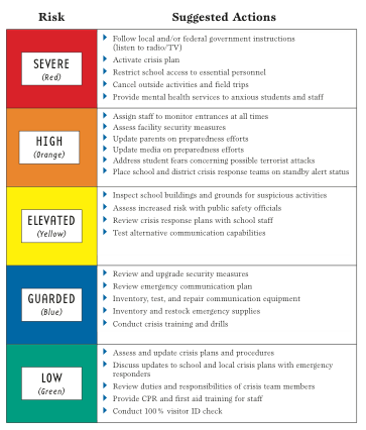
Sample School Advisory System
Student Release
Student release is a crucial part of crisis planning. In all school crisis planning, the safety of the students is the main priority. During a crisis, traditional student release procedures are frequently unsafe or otherwise inoperable. Accordingly, a comprehensive crisis plan needs to include certain procedures:
- Update student rosters.
- Rosters should be updated at a minimum of twice a year; some districts recommend updating rosters weekly.
- Distribute updated rosters.
- All teachers need updated rosters of all their classes. This information should be stored in their classroom so that a substitute teacher could easily find it. A copy of all rosters should also be placed in the crisis response box, as well as with the principal and any other stakeholder as advisable. It is critical to know which students are present during a crisis.
- Create student emergency cards.
- At the beginning of the school year, make sure the school has an emergency card for each student containing contact information on parents/guardians, as well as several other adults who can be contacted if the parent or guardian is not available. The card should also indicate whether the student is permitted to leave campus with any of the adults listed on the card, if necessary. Some districts recommend authorizing one or more parents of children at your child’s school to pick up your child. The card should also include all pertinent medical information, such as allergies, medications, and doctor contact information. These cards should be stored in the front office, both in hard copy and electronically, if possible.
- Create student release forms to be used in times of crisis and store them with crisis response materials.
- Create a back-up plan if forms are not available.
- Designate student release areas, as well as back-up options.
- These areas should be predetermined and communicated to families. If necessary, changes should be communicated through the designated channels.
- Assign roles for staff.
- For example, a staff member is needed to take the emergency cards from the office to the release area, while several staff members are needed to deal with families and sign out students. These roles should be assigned before a crisis occurs. If roles change, the principal or designated leader should assign new roles.
- Create student release procedures.
- These procedures should create a flexible, yet simple, system for the release of students. Families will want immediate access to their children; emotions will be running high. Create a system that considers this, and train staff to expect it. Procedures should require proof of identity; if necessary, wait until such proof can be ascertained. It is important not to release a student to a noncustodial guardian if custody is an issue for the family. Do not release students to people not listed on student emergency cards. A well-intentioned friend may offer to take a child home; however, school staff must be certain that students are only released to the appropriate people so students’ families will know where they are.
- Arrange for transportation for students who are not taken home by a parent or guardian.
- Also arrange for shelter and provisions, if necessary.
- Use all communication outlets to keep families, the media, and community informed during and after the crisis.
- Signal the end of the crisis as well.

Preparing Students, Staff, and Stakeholders to Respond
- Provide regular, comprehensive trainings for teachers and staff.
- At least once a year, provide crisis response training for teachers and staff. Also provide make-up trainings for those unable to attend the regular training session. Go through the crisis plan and procedures in order to familiarize all school personnel with it. Periodically remind staff of signals and codes.
- Visit evacuation sites with staff and stakeholders.
- Show involved parties not only where evacuation sites are but also where specific areas, such as student reunification areas, media areas, and triage areas will be.
- Give all staff, stakeholders, and families literature corresponding to the crisis plan.
- While all staff should have a copy of the crisis plan, it will also be helpful to provide them with pamphlets reminding them of key principles. Families and community members should also receive literature summarizing crisis procedures and information pertaining to them. Provide each classroom with a copy of the crisis plan and any relevant materials, supplies, and equipment.
- Require a specific number of crisis drills every year.
- Most states require fire drills; the same should be true of crisis drills. This need not be an extra burden; work with state and district laws for possible options. In Arizona, for example, schools are permitted to use some of the mandated fire drills for crisis drills. Also, speak with students about the importance of drills and explain that while they are serious, students should not be frightened.
- Conduct tabletop exercises and scenario-based drills regularly.
- While actual drills and training are essential, it is also helpful to have group brainstorming activities that can be done informally around a table. These can be held with stakeholders, staff, community members, and first responders. Students can be involved as well.