Common Indicators
Refer to Participant Handouts p. 6-8.
- An indictor is a “sign” that points to or represents something else. Therefore, an indicator for child abuse or maltreatment serves as a warning or alert, telling you that more attention should be given to a particular circumstance.
- There are three types of indicators to consider:
-
- Physical indicators
- Child’s behavioral indicators
- Parent’s behavioral indicators
- At times the identification of suspected child abuse and maltreatment of suspected child abuse and maltreatment may be self-evident and can rest on a single factor: a handprint, a bruise, positive toxicology at birth, or a disclosure made by a child.
- More often, identifying indicators can be more difficult. Your suspicion that a child has been abused or maltreated may rest on pulling together several indicators or clusters of indicators.
- DO NOT view indicators provided in your handouts in isolation. Indicators must be considered in relation to the child’s current condition or circumstance. The presence of an indicator should be considered in the overall context of a child’s physical appearance and behavior.
- At times indicators may seem to contradict themselves. For example:
A six year old female was experiencing difficulty in sitting and walking. Mother also noticed her daughter’s vaginal area was swollen and irritated. However, a follow-up medical examination revealed that the child was suffering from a urinary tract infection due to poor hygiene practices.
- Each of your unique experiences with children needs to be considered when assessing for suspicion.
- Some of you may see a child once (e.g., EMT or law enforcement), others on a daily or regular basis (e.g., teachers or school nurse).
- You must carefully determine if the child’s behavior deviates from the “norm” for that child. Ask yourself, “What is ‘normal’ based on what I know of the child and/or the developmental stage and the child’s age?”
- No two children respond to the same situation in the same manner. Children will have different responses.
- Also consider the behavior of the parent or other legally responsible individual. if you are being provided information that leads you to suspect abuse or maltreatment, consider the quality of the disclosure and the information you are provided. Ask yourself: ”Is this explanation plausible? Are they repeating gossip or are they speaking from personal knowledge? What are they saying about the child’s condition or behavior?”
- Abuse or maltreatment should never be assumed. Moreover, many abused or maltreated children may not show any of these indicators.
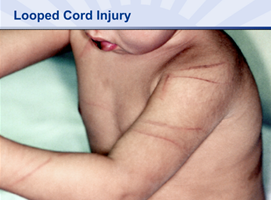
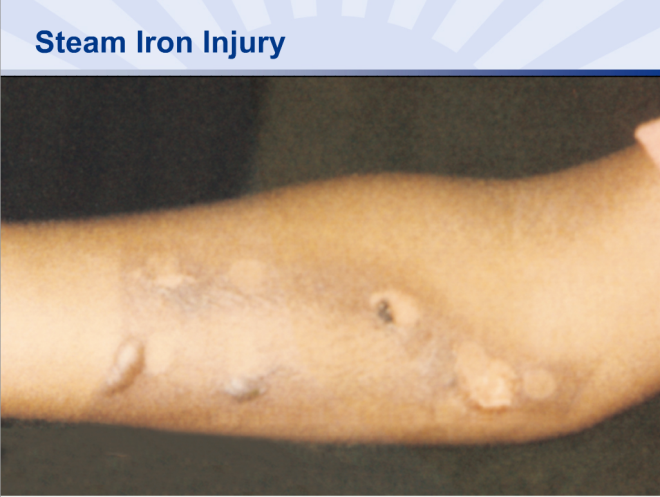
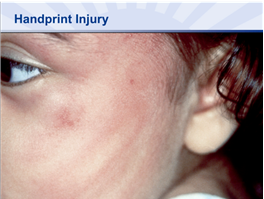
The three photos above can be used to illustrate what some injuries may look like.
Key Points:
- Handprint Injury
This photo illustrates linear markings on a child’s cheek caused by the slap of a hand. From this photo the child appears to be very young. A hand slap to the head of a very young child with enough force to cause this type of mark is clearly not accidental. Consider the age of the child and the type and location of the injury in determining your suspicions.
2. Looped Cord Injury
This photo depicts a three-year-old repeatedly struck on the arm with a looped cord.
3. Steam Iron Injury
This photo depicts an intentional steam iron burn to a six-year-old’s arm. Note how clearly the pattern is and the visibility of the steam jet holes. Remember to consider the age of the child, the type of injury, and the explanation of how the injury occurred.